
 This is Part 2 (of 3) about conducting a StartupTherapy™ process with your team. You may remember from my last post, focused on StartupTherapy™ pre-work, that I have long (sort of) joked that you either get StartupTherapy™ or the founding team ends up in serious therapy. Entrepreneurship will test you and your relationships, so prepare for process and the stress in advance! This is the heart of StartupTherapy™.
Our StartupTherapy process includes 10 key discussion questions/topics and this post walks you through the first 5 of the 10! They will begin to help you address culture, communications, power dynamics, vision and commitment. Frankly it requires a level of emotional openness and candor that not every team is comfortable with. But you’d better get comfortable or your startup will likely collapse. I’ve got a lot of posts and resources about StartupTherapy™, but this is about how to conduct an in depth StartupTherapy™ process with your own team.
When Did Entrepreneurship become Emotional? There are 10 Key StartupTherapy™ questions to discuss with founding team and this post covers questions 1-5
What should we ask during StartupTherapy™?
 StartupTherapy™ – 10 Key Steps and Questions
- Introduce each person’s background and start up experience
- What are your Reasons to Startup?
- Next Gig – Where will you each be in 5 years?
- SWOT: Founder Strengths, Weaknesses, Opportunities, Threats
- Secret Fears about doing a startup
- Vision for the startup and its purpose in the world
- Values of the Company
- Talent Gap Analysis
- Financing strategy – bootstrap/self, partner, investor
- Business Model
Go around the room for each step
 1. Introduce each person’s background and start up experience
- You may be surprised (one of our friends worked for the CIA?!?!)
- Get people talking
- Go Deep
- Really know your team
- Look for red flags or concerns
- Do you have the Right People on the Bus?
2. What are your Reasons to Startup?
- Each person should provide (at least) 2 reasons why they want to be in the startup
- Making Money or Getting Rich does not count as a reason!
- If “getting rich” is your only motivation, it will surely not be enough to get you through the hard stuff!
- Listen for consistent – or divergent – motivations among the team and be ready to address these
- Do you Have the Right People on the Bus? (See Jim Collins’ work on the Right People on the Bus)
 3. Next Gig – Where will you each be in 5 years?
- Where does each person want to be, personally, 5 years after the startup?
- This is the Startup equivalent of a pre-nup
- What experiences will each person seek for during the startup?
- Is that what the startup needs?
- Right People on the Bus?
Thoughts on Your Next Gig!
Your first deal won’t be your last because entrepreneurship isn’t an event, it’s a lifestyle. For most people, your first gig is often “your baby” and your own idea. Your next gig is likely about the process of entrepreneurship. My Dad (a global CEO), once told me that most of the entrepreneurs he knew had made their “big money” on their third deal!
 A good VC once said to me that the worst entrepreneur is one who’s had a big success the first time – you can’t tell them anything! He’d rather back someone who had failed and learned, particularly if it’s their third time out (one success, one failure, then poised for bigger things). Truthfully, once you have the entrepreneurship bug, you can’t quit! So plan for that.
4. SWOT: Strengths, Weaknesses, Opportunities, Threats
- The team needs each founding team member to perform and to share a SWOT – their personal strengths and weaknesses vis a vis the startup and the startup’s needs!
- This includes both personal and life partner risk taking profile, financial runway etc
- A founder with a partner who is highly risk adverse will always be unhappy with the built-in uncertainty of a startup (because their partner will always be unhappy). It is not fixable. Period. Better to know now than later
- Identify the skills that each person has that the company needs for success…
- You should consider running your own SWOT for EACH OTHER and see if these match (even if only privately)
- A KEY ISSUE: Many times founders diverge in their appetite for risk
- Sometimes a founder refuses to put themselves on the line for the startup – even though they want that big chunk of founders shares
- Right People on the Bus?
5. Secret Fears
- Each person should share their Secret Fears about doing a startup
- Need I say more?
After you’ve gone through the first five questions, can you see how deep it is possible to go? And how important what you will learn about yourself and the rest of your team? You can certainly break up the process into multiple parts! It can be overwhelming to do it all at once. And yes, when we founded DoBox, we did do the first version of StartupTherapy™! It was organic, and it just seemed like the things we should discuss, and of course I’ve refined the questions over many years, but it was important then, and it’s important now. Way too many startups fail to achieve their vision because these issues get in the way. Don’t let that be your startup!
Visit How to Conduct a StartupTherapy™ Session – Part 1 – Pre-Work for first steps. This post, How to Conduct a StartupTherapy™ Session – Part 2 (First 5 Questions) is the second part of the process. Next month, part 3 of StartupTherapy™ and the last 5 questions.
If you want advice and support as you build out your team, check out our StartupTherapy™ Resources and Help page! Lots of great help.
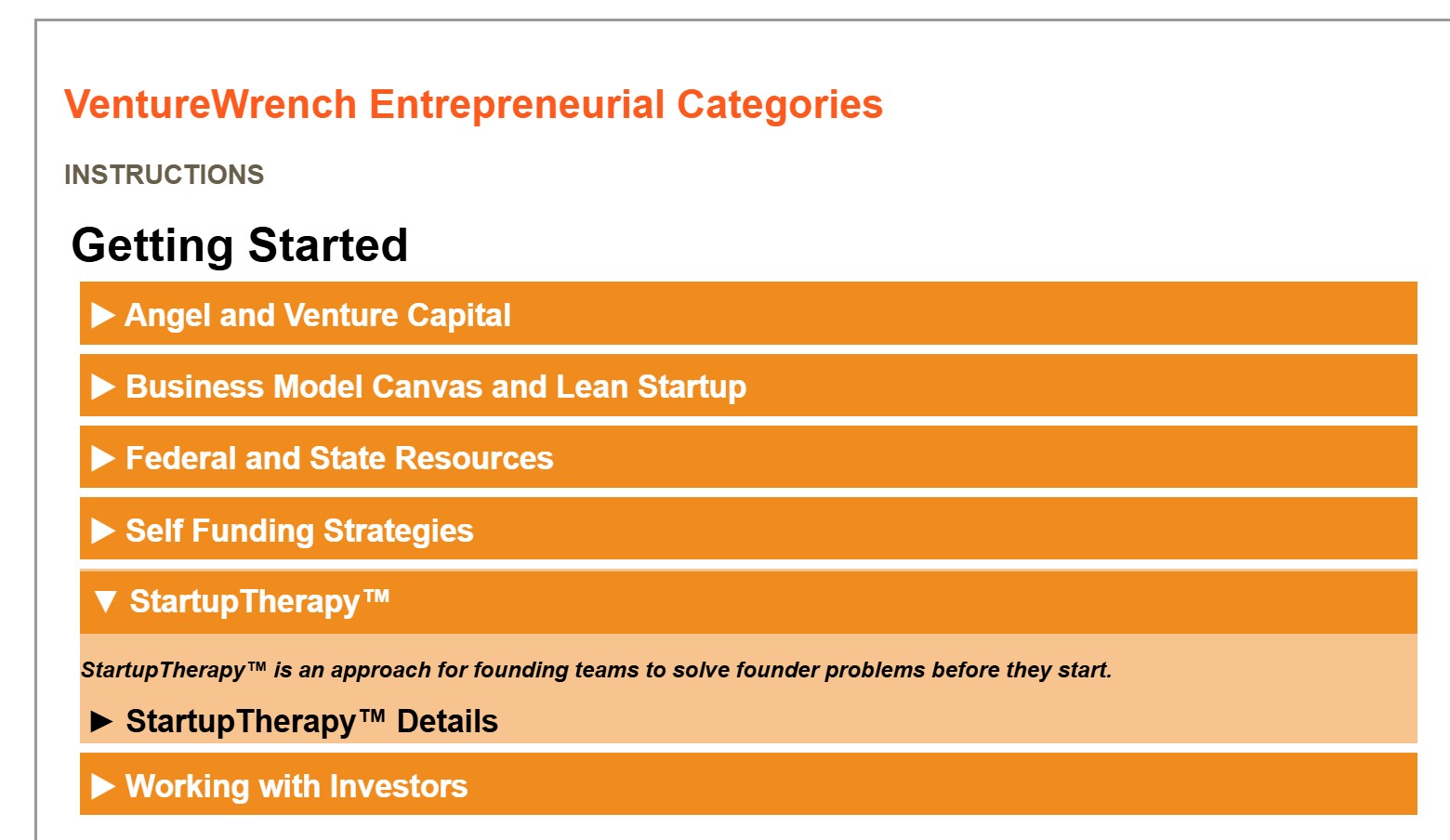
To get even more great Designer Investor™ content, visit the VentureWrench Library at Library.VentureWrench.com, our AI-powered library of resources to help entrepreneurs.
You can login with a secure account to save your preferences, or visit using “guest” instead of an email address (leave the password blank).
Select Angel and Venture Capital and then explore for more curated content.
If you are looking to raise capital in this market, I strongly encourage you to get help! Don’t go it alone!
We have lots of NO COST content on our blog, as well as our modestly priced resources on Capital Raising Coaching and Potential Investor Identification – “Designing the Perfect Investor™” and “InvestorFind™ Investor Identification Support“.
In addition, if you are interested in Individual Coaching see our offerings on CEO and Entrepreneur Coaching. If you’d like more details, email venturewrenchcommunity [at] gmail.com.
Interested in creating an SBIR proposal?
Click to Get our free guide “40 Ways to Improve your SBIR/STTR proposal!
If you are planning to raise funding for your startup,
Click to Get our FREE VentureWrench Guide to Investor Capital
50 pages of insider insights to help you succeed!